Data sovereignty meaning: a clear explanation for IT leaders
What data sovereignty actually means for AI: which jurisdiction governs your data, who can compel access, and why it matters for compliance.
by Elias Mahdavi · Published on · 8 min read
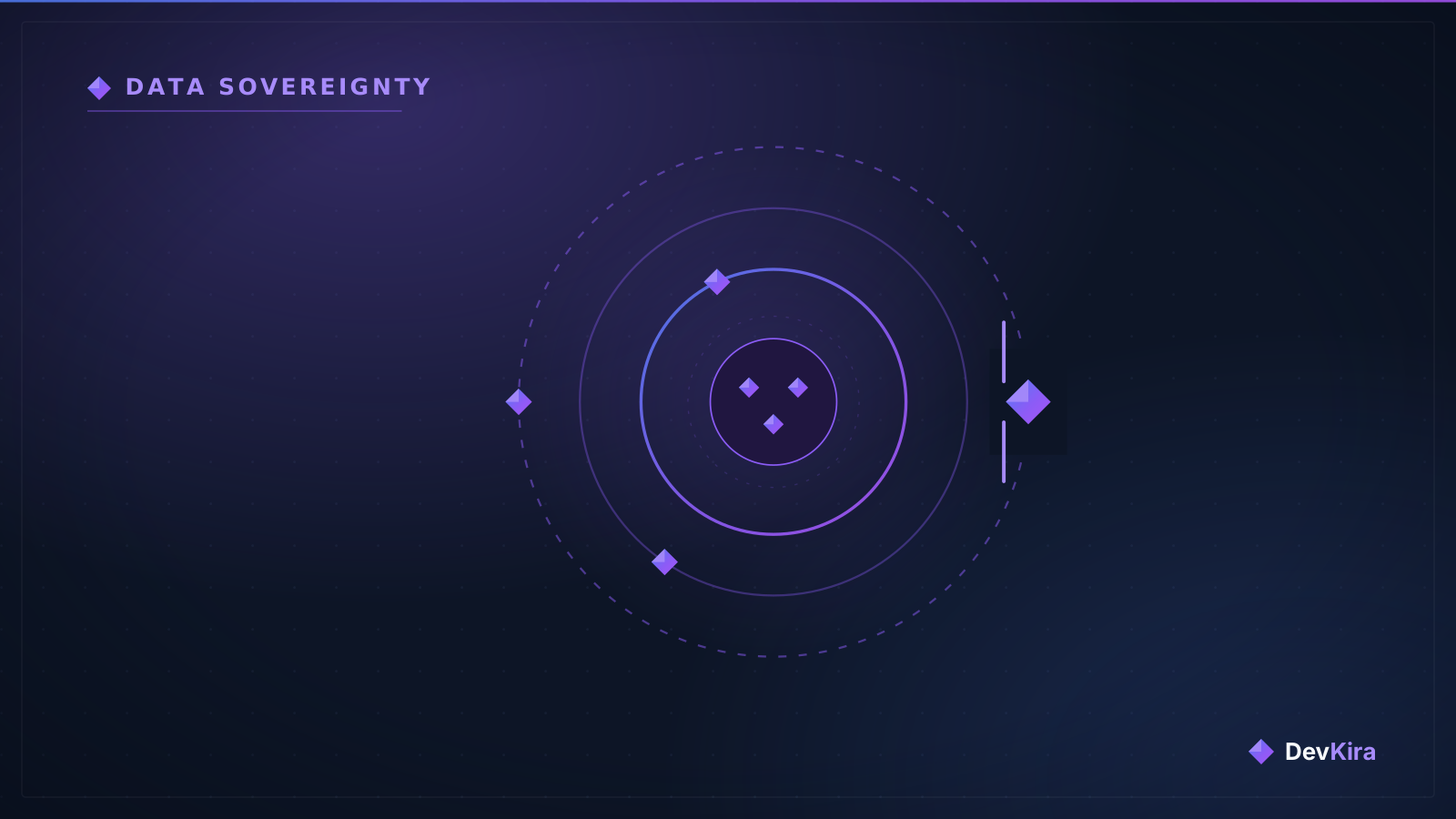
Data sovereignty means data is subject to the laws of the jurisdiction where it is processed, and specifically, for AI, which country's authorities can compel access to a model's prompts and outputs. Storing data in a European data centre does not resolve this if the provider is a US company, since the US CLOUD Act can still compel disclosure.
Key takeaways
- Data sovereignty means data is governed by the laws of the jurisdiction it is processed in, and specifically who can be legally compelled to hand it over.
- For AI, the relevant data isn't just storage; it's every prompt sent to a model and every output that model returns.
- A "sovereign cloud" claim about infrastructure location does not automatically resolve sovereignty if the AI model provider itself is subject to a foreign jurisdiction, such as the US CLOUD Act.
- Data sovereignty for AI has three practical postures: masked cloud, EU-sovereign, and fully on-premise, each suited to a different sensitivity of data.
- The generic "sovereign cloud" market is dominated by large infrastructure vendors; the sharper, more answerable question for AI specifically is where prompts and outputs are processed, and under whose jurisdiction.
- Genuine data sovereignty for AI has to be enforced at the point a request is routed, not asserted afterwards in a vendor's marketing page.
Contents
- Data sovereignty meaning: the short version
- What is a sovereign cloud?
- Why data sovereignty matters specifically for AI workloads
- Three postures for governing AI data sovereignty
- 6 questions that reveal whether an AI vendor actually offers data sovereignty
- Data sovereignty, the EU AI Act and UK GDPR
- Frequently asked questions
- Choosing the right posture for your data
Data sovereignty meaning: the short version
Data sovereignty means that data is subject to the laws of the country or bloc where it is processed, and, critically, that a foreign government cannot compel access to it through legal mechanisms your own jurisdiction doesn't recognise. It is a legal and jurisdictional concept before it is a technical one.
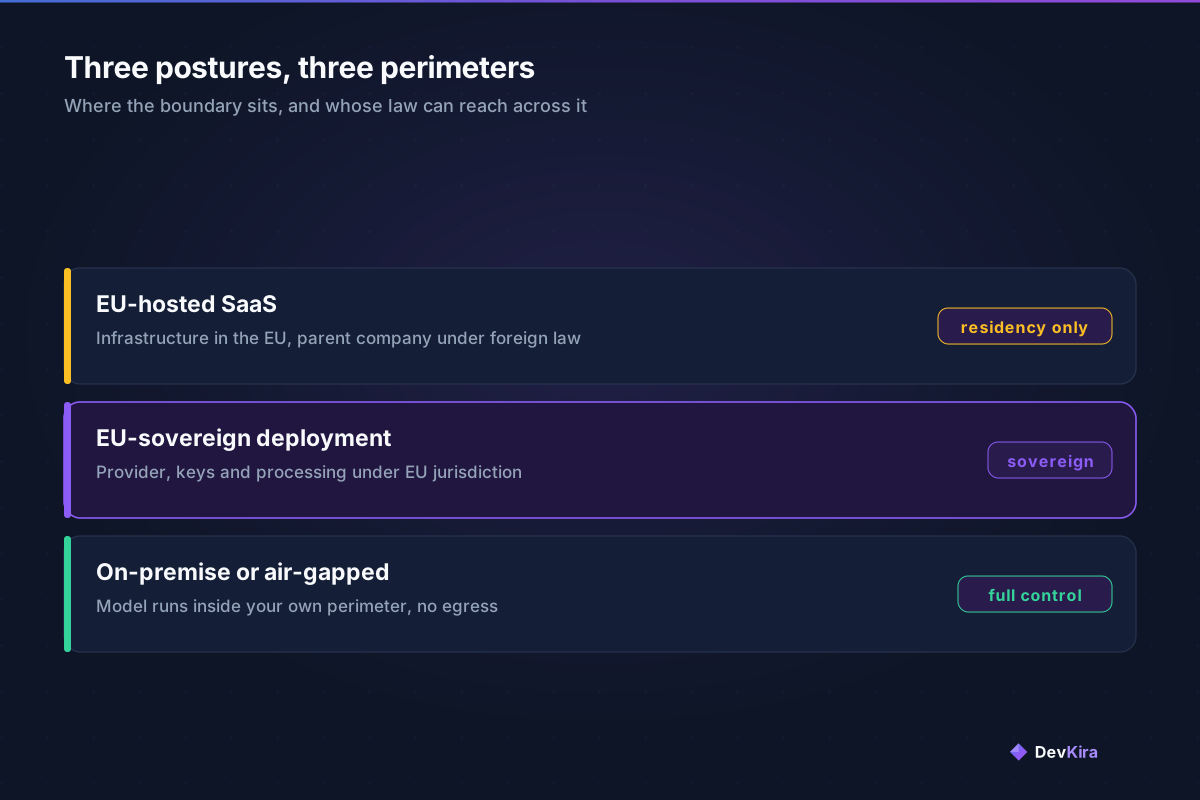
The confusion most IT leaders run into is conflating sovereignty with residency. Data residency asks where the bytes physically sit. Data sovereignty asks a harder question: which country's courts can force the company holding those bytes to hand them over, regardless of where the data centre is. A European data centre operated by a US-headquartered company does not automatically answer that in your favour.
What is a sovereign cloud?
A sovereign cloud is cloud infrastructure operated under a specific jurisdiction's legal control, designed so that only that jurisdiction's laws, not a foreign government's, can compel access to the data it holds. The term is used heavily by large infrastructure vendors, Oracle, IBM, Google, Microsoft and SAP among them, each offering a regional or jurisdictionally ring-fenced version of their standard cloud product.
For AI workloads specifically, "sovereign cloud" answers only half the question. Infrastructure location and legal control over the hosting layer matter, but an AI request also passes through a model provider, and that provider's own jurisdiction matters just as much as the data centre's. A sovereign-cloud data centre running a model built and operated by a company subject to a foreign disclosure law has not actually closed the exposure; it has moved it one layer up the stack.
Why data sovereignty matters specifically for AI workloads
Data sovereignty matters more for AI than for ordinary data storage because the sensitive material isn't sitting passively in a database; it is actively sent, as a prompt, to a model, and returned as an output that may itself contain or reveal sensitive detail. Every single request is a data transfer event, not a one-time storage decision.
The US CLOUD Act is the clearest illustration of why this distinction matters. Enacted in 2018, it allows US law enforcement to compel a US-based provider to disclose data it controls, regardless of where in the world that data is physically stored. A prompt sent to a US-headquartered model provider can, in principle, be reached this way even if the servers processing it sit inside the EU.
Three postures for governing AI data sovereignty
Rather than treating sovereignty as one binary switch, it is more useful to treat it as a choice made per class of data, matched to how sensitive that data actually is.
| Posture | What it means | When to use it |
|---|---|---|
| Masked cloud | Best-in-market models used compliantly, with sensitive data masked before it ever leaves the workspace | The minimum acceptable bar for everyday compliant AI use |
| EU-sovereign | A European provider, such as Mistral, operating under EU jurisdiction, resolving both data-transfer exposure and US CLOUD Act reach while keeping model quality high | Most corporate data that is sensitive but not extreme |
| On-premise | An open-weight model running entirely on the organisation's own servers, with no third party in the processing chain at all | Critical data: industrial plans, trade secrets, material that cannot leave the perimeter under any circumstance |
DevKira routes requests to one of these three postures at the gateway layer, so the decision about where a given class of data is permitted to go is enforced automatically rather than left to whichever model an employee happens to have open, a mechanism covered in more technical depth in <a href="/en/blog/llm-gateway-explained">how an LLM gateway enforces routing and sovereignty at the point of every request</a>.
6 questions that reveal whether an AI vendor actually offers data sovereignty
Marketing language around sovereignty is dense and often answers a narrower question than the one being asked. These six questions cut through it.
1. Which specific jurisdiction is the processing infrastructure physically located in?
Not "Europe" in general; the actual country, since intra-EU jurisdiction still varies in practice.
2. Which country's law can compel the vendor to disclose your data?
This is the US CLOUD Act question, and it depends on where the vendor is headquartered, not where its servers sit.
3. Is the model provider itself under the claimed jurisdiction, or only the hosting infrastructure beneath it?
A jurisdictionally ring-fenced data centre running a foreign-controlled model has not resolved the exposure; it has relocated it.
4. Can sensitive data be masked or redacted before it leaves your environment at all?
This is the control that makes using best-in-market models compliant even before a full sovereign posture is in place.
5. Is there a genuine on-premise or air-gapped option, not just a "regional" promise?
For the most sensitive data, the only complete answer is a model that never sends anything outside the perimeter at all.
6. Does the sovereignty guarantee cover the AI model specifically, or only general cloud storage?
Many sovereignty claims were written before generative AI existed and were never updated to address prompts and model outputs as their own category of data in motion.
Data sovereignty, the EU AI Act and UK GDPR
Data sovereignty and data protection law overlap but are not the same question; sovereignty asks who can compel access, while GDPR and UK GDPR ask what legal basis exists for processing personal data at all, and both apply simultaneously to an AI request that includes personal data.
The <a href="https://eur-lex.europa.eu/eli/reg/2016/679/oj" target="_blank" rel="noopener">GDPR text itself (Regulation (EU) 2016/679)</a> sets out restrictions on transferring personal data outside the EU, which is precisely the exposure an EU-sovereign or on-premise posture is designed to avoid entirely rather than manage through contractual safeguards after the fact. The <a href="https://www.edpb.europa.eu/our-work-tools/our-documents/topic/artificial-intelligence_en" target="_blank" rel="noopener">European Data Protection Board's guidance on AI</a> addresses this transfer question directly for AI model processing, not just conventional storage. On the UK side, the Information Commissioner's Office is explicit in its <a href="https://ico.org.uk/for-organisations/uk-gdpr-guidance-and-resources/artificial-intelligence/guidance-on-ai-and-data-protection/" target="_blank" rel="noopener">guidance on AI and data protection</a> that an organisation must be able to account for where personal data processed by an AI system actually goes, which is difficult to answer honestly without a defined, enforced sovereignty posture behind it.
Frequently asked questions
What is a sovereign cloud?
A sovereign cloud is cloud infrastructure operated under a specific jurisdiction's legal control, so that only that jurisdiction's laws can compel access to the data it holds. Major vendors including Oracle, IBM, Google, Microsoft and SAP offer versions of this, but for AI specifically, the model provider's own jurisdiction matters as much as the infrastructure's.
What does data sovereignty mean in simple terms?
It means the data is governed by the laws of wherever it is actually processed, and specifically, which government can force disclosure of it. It is a legal control question, not merely a question of which country a data centre happens to be built in.
Is data sovereignty the same as data residency?
No. Data residency describes where data is physically stored. Data sovereignty describes which jurisdiction's laws and disclosure powers apply to it, which depends on who controls the processing, not only where the servers are located.
Does the US CLOUD Act apply even if data is stored in Europe?
It can. The US CLOUD Act, enacted in 2018, allows US authorities to compel a US-based provider to disclose data it controls regardless of where that data is physically stored, which is why EU server location alone does not resolve US jurisdiction exposure.
Why isn't a "sovereign cloud" claim enough for AI specifically?
Because an AI request involves an active model provider, not just passive storage. A sovereign-cloud data centre can still run a model operated by a company subject to a foreign jurisdiction, which means the exposure moves to the model layer even when the infrastructure layer is genuinely sovereign.
What is the difference between EU-hosted and EU-sovereign?
EU-hosted typically means the servers are physically located in the EU, while the operating company may still be headquartered elsewhere and subject to foreign law. EU-sovereign means the provider itself, not just the infrastructure, operates under EU jurisdiction.
Choosing the right posture for your data
Most organisations do not need every category of data locked to the strictest posture available; they need a defined, enforced answer for each category, applied consistently rather than decided ad hoc by whoever opens a model that day. That decision connects directly to the wider governance question of who is allowed to use which model on which data, covered in <a href="/en/blog/what-is-ai-governance">what AI governance means and how it works in practice</a>, and to the risk of that decision being skipped entirely, covered in <a href="/en/blog/what-is-shadow-ai">what shadow AI is and why it bypasses sovereignty controls by default</a>.
To see masked cloud, EU-sovereign and on-premise routing enforced automatically at the point of every request, <a href="/en/book-a-demo">book a DevKira demo</a>.